Why Your Inverter or Generator Shuts Off: Starting Watts vs Running Watts
You bought a 2,000-watt inverter, the refrigerator label says 700 watts, and the inverter still shuts down with an overload alarm the moment the compressor kicks in. Nothing is defective. You have run into the difference between running watts and starting watts.
Any appliance with a motor or a compressor needs a short burst of extra power when it starts, typically two to four times its normal draw for about half a second. Purely resistive loads such as heaters, kettles and incandescent bulbs do not have this surge.
Running watts vs starting watts
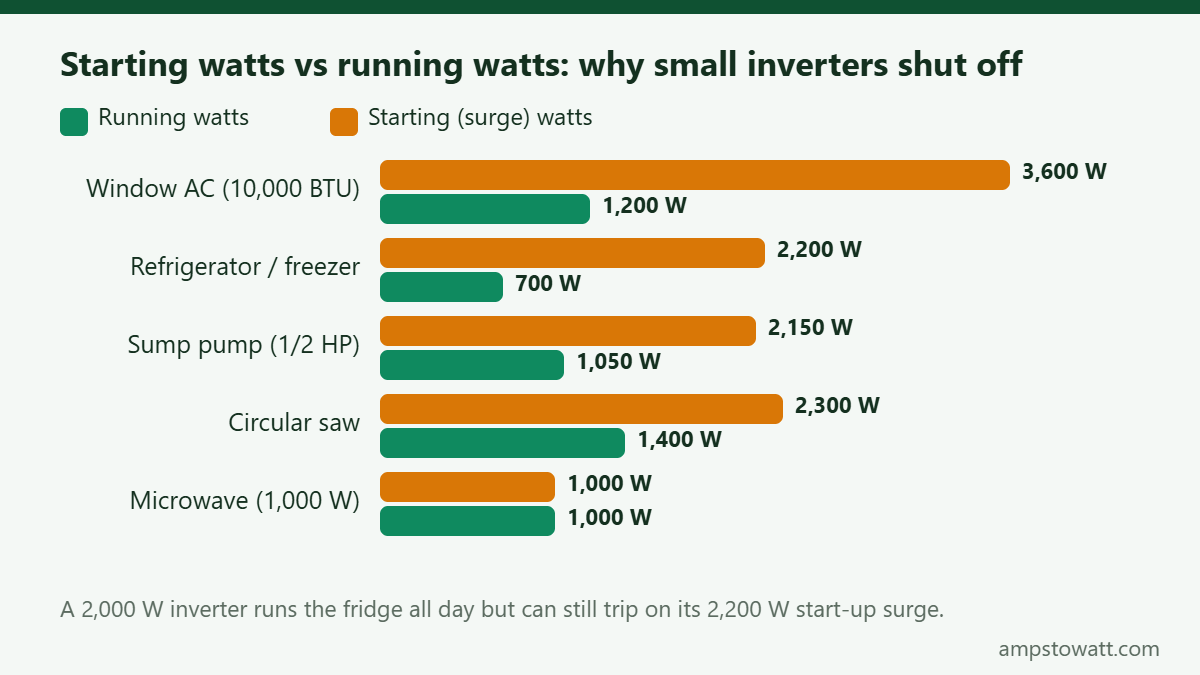
Running (rated) watts is the steady draw once the motor is spinning. Starting watts, also called surge, peak or inrush watts, is the burst needed to get it moving. A typical refrigerator runs at about 700 W but surges to around 2,200 W. A 10,000 BTU window air conditioner runs at 1,200 W and can surge to 3,600 W.
| Appliance | Running watts | Starting watts |
|---|---|---|
| Refrigerator / freezer | 700 W | 2,200 W |
| Window AC (10,000 BTU) | 1,200 W | 3,600 W |
| Sump pump (1/2 HP) | 1,050 W | 2,150 W |
| Circular saw | 1,400 W | 2,300 W |
| Microwave (1,000 W) | 1,000 W | 1,000 W |
| LED TV + router | 150 W | 150 W |
Inverters and generators publish two numbers as well: continuous watts and peak (surge) watts. A “2,000 W” inverter usually means 2,000 W continuous and about 4,000 W peak for a few seconds. A budget unit may only allow 2,200 W peak, which is exactly where the refrigerator trips it.
Why the amps on the battery side matter
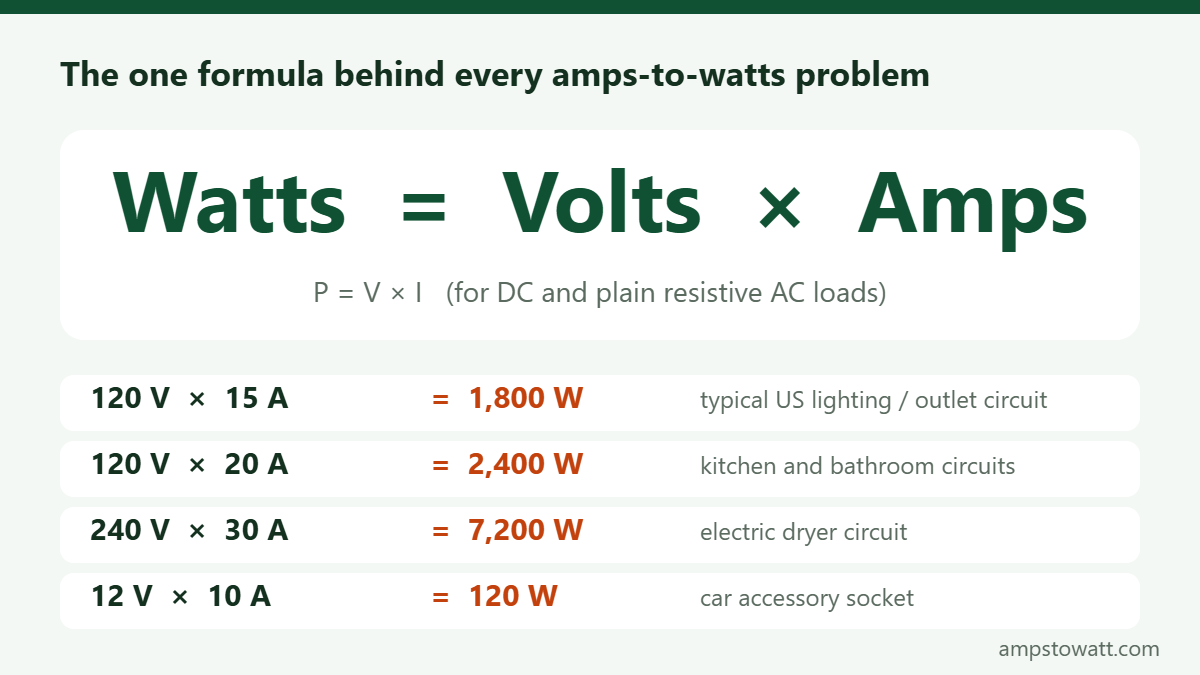
On a 12-volt battery system the amps are brutal. Amps = Watts ÷ Volts, so a 2,200 W surge pulls roughly 2,200 ÷ 12 = 183 A from the battery for that half second, before inverter losses. Thin cables or a tired battery cannot deliver it, the voltage sags, and the inverter shuts off on low voltage even though the wattage looked fine on paper.
Rule of thumb: size the inverter cables for the surge, not the running load, and keep the battery-to-inverter run short. On a 24 V system the same surge is 92 A; on 48 V it is 46 A, which is why larger systems use higher battery voltages.
How to size the inverter or generator correctly
- Add up the running watts of everything that will be on at the same time.
- Find the single largest starting surge among those loads.
- Add that surge to the running watts of the other loads.
- Choose a unit whose continuous rating covers step 1 with about 20% headroom and whose peak rating covers step 3.
Example: a refrigerator (700 W running, 2,200 W starting), a router with lights (150 W) and a laptop (65 W). The running total is 915 W. The worst-case start is 2,200 + 150 + 65 = 2,415 W. A 1,500 W continuous / 3,000 W peak inverter handles this comfortably; a 2,000 W / 2,200 W unit does not.
Fixes when you cannot buy a bigger unit
- Fit a soft-start kit to an air conditioner or pump; it cuts the surge by 60 to 70%.
- Start the largest motor first, on its own, then switch on the other loads.
- Never start two motors at the same moment.
- Use a pure sine wave inverter for compressors; modified sine wave adds heat and inrush.
- Check the battery voltage under load. A sagging battery mimics an overload perfectly.
Quick check before you blame the inverter
Read the inverter’s peak rating, find the appliance’s starting or locked-rotor watts on its nameplate, and compare the two. If the surge is higher than the peak rating, no amount of resetting will help; a soft-start kit or a larger unit will. Our inverter size calculator and generator wattage calculator do the math for you.
And if the shutdowns happen only at night or after a few hours, check the battery voltage under load before anything else. Low voltage, not too many watts, is the most common reason a correctly sized inverter still cuts out.