W How do I convert amps to watts?
Multiply amps by volts to get watts. For example, 10 amps at 120 volts equals 1,200 watts (10 × 120 = 1,200). For AC circuits with motors or compressors, also multiply by the power factor from the equipment nameplate.
AC What is the formula for amps to watts?
There are three formulas depending on the circuit type. DC: Watts = Amps × Volts. AC single-phase: Watts = Amps × Volts × Power Factor. AC three-phase (line-to-line): Watts = 1.732 × Amps × Volts × Power Factor. For three-phase line-to-neutral: Watts = 3 × Amps × Volts × Power Factor.
1A How many watts are in 1 amp?
1 amp equals a different number of watts depending on the voltage. At 12V, 1 amp = 12 watts. At 120V, 1 amp = 120 watts. At 240V, 1 amp = 240 watts. This assumes power factor of 1.00. For AC motor loads with lower power factor, the real watts will be lower.
V Do I need voltage to convert amps to watts?
Yes — you cannot convert amps to watts without knowing the voltage. Amps measure current flow, and watts measure power. The relationship is Watts = Amps × Volts. Without voltage, there is no way to determine how much power the current represents. A 10-amp load could be 120 watts (at 12V) or 2,400 watts (at 240V).
PF Why does AC amps to watts need power factor?
Power factor (PF) measures how efficiently a device uses current. Resistive loads like heaters use all the current for real work (PF = 1.0). Motors and compressors draw extra current due to inductance, so their power factor is lower (0.70–0.95). Without accounting for PF, you would overestimate watts by 10–40% for these loads.
VS What is the difference between amps and watts?
Amps (amperes) measure the flow rate of electric current — how much charge passes a point per second. Watts measure electric power — the rate at which electrical energy is used or converted to heat, light, or motion. You need both amps and volts to calculate watts: Watts = Amps × Volts.
3P How do I convert three-phase amps to watts?
For three-phase with line-to-line voltage: Watts = √3 × Amps × Volts × Power Factor (√3 ≈ 1.732). For line-to-neutral voltage: Watts = 3 × Amps × Volts × PF. Example: 10A at 480V with PF 0.90 using line-to-line voltage = 1.732 × 10 × 480 × 0.90 = 7,478 watts.
Wh Is watts the same as watt-hours?
No. Watts (W) measure instantaneous power — how fast energy is being used right now. Watt-hours (Wh) measure total energy consumed over time. A 100-watt light bulb running for 3 hours uses 300 watt-hours (0.3 kWh). Your electricity bill charges per kilowatt-hour, not per watt.
APP Can I use this calculator for appliances?
Yes. Enter the amperage from the appliance nameplate, the outlet voltage (120V or 240V in the US), and power factor if listed. For resistive appliances (heaters, toasters, hair dryers), use PF = 1.0. For motor-driven appliances (refrigerators, AC units, washing machines), use the nameplate PF or estimate 0.85.
SA Can I use this calculator for breaker or wire sizing?
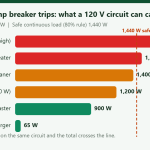
You can use the result for load planning, but not for final breaker or wire sizing. The NEC requires that continuous loads (3+ hours) stay at or below 80% of the breaker rating. Final sizing must account for wire gauge, ambient temperature, conduit fill, voltage drop, and local code. Always consult a licensed electrician for safety-critical work.