Why Does My Breaker Keep Tripping? Amps vs Watts Overload, Solved
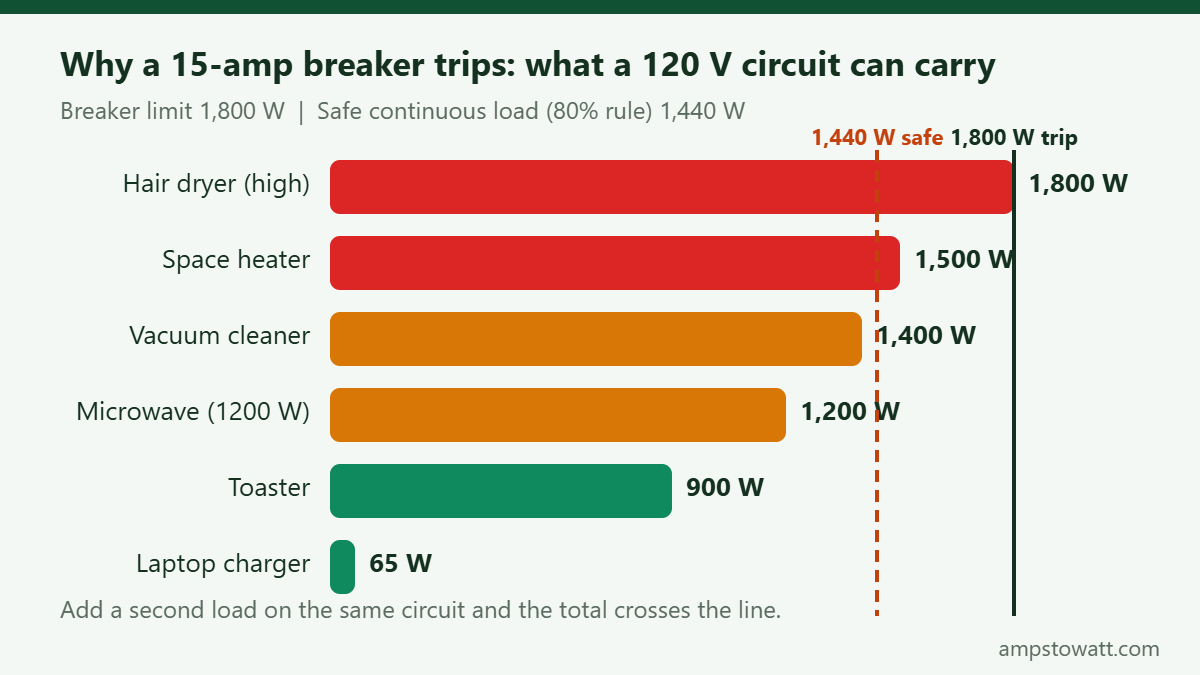
If the breaker trips every time the space heater or hair dryer switches on, nothing is broken. The breaker is doing exactly what it is designed to do: the circuit is being asked to carry more amps than it is rated for. The fix starts with one simple watts-to-amps conversion.
Here is the short version. A standard 15-amp, 120-volt household circuit can deliver 1,800 watts at its absolute limit, and only about 1,440 watts safely for anything that runs for a long time. A single heater, hair dryer or vacuum takes 1,200 to 1,800 watts on its own, so two of them on one circuit is already too much.
Step 1: Turn the watts on the label into amps
Appliance labels show power in watts (W), while breakers are rated in amps (A). To compare them, divide watts by volts: Amps = Watts ÷ Volts. A 1,500 W space heater on a 120 V outlet draws 1,500 ÷ 120 = 12.5 A.
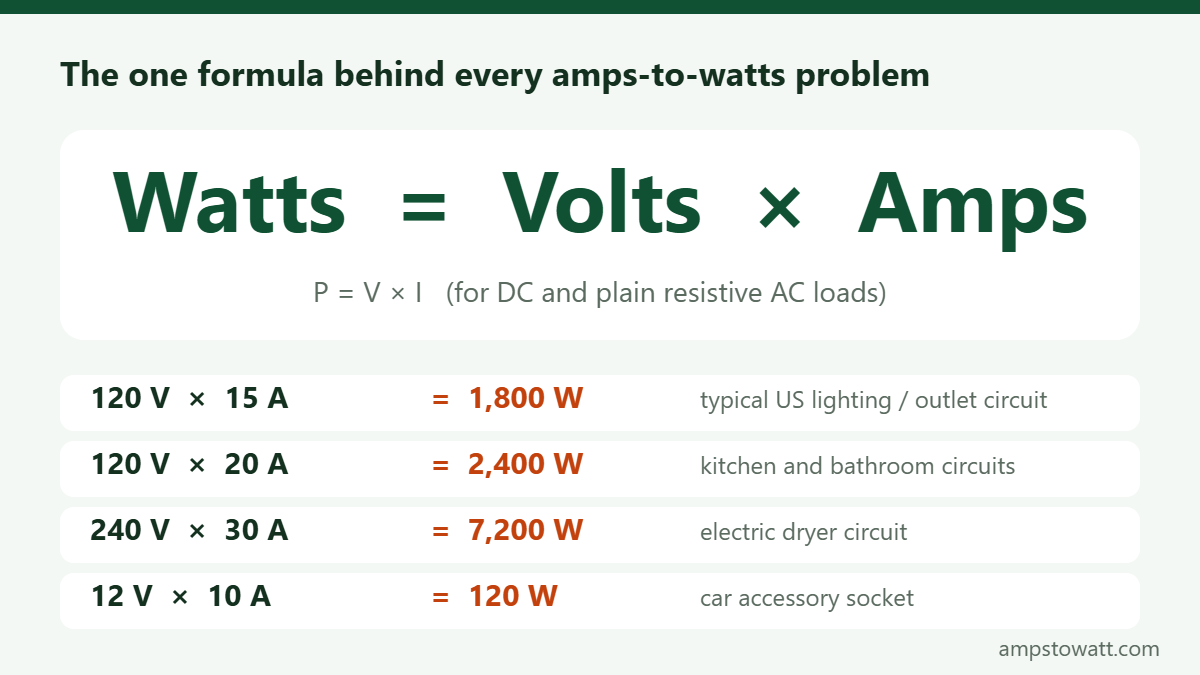
That one heater already uses 83% of a 15-amp breaker. Add a 60 W lamp and a phone charger and you are still fine. Plug a 1,200 W microwave into the same circuit and the total jumps to 22.5 A, far past the trip point.
Step 2: Find out what else shares the circuit
Switch the breaker off on purpose and walk through the house. Every outlet and light that goes dark is on that circuit. Many homes wire two bedrooms, or a kitchen counter and a dining room, to one 15-amp breaker.
Write down the wattage of everything that normally runs on that circuit at the same time. Refrigerators, TVs, routers and lamps count too, even though each one draws very little.
Step 3: Apply the 80% rule
Electrical codes treat anything that runs for three hours or more as a continuous load and limit it to 80% of the breaker rating. For a 15 A breaker that is 12 A, or 1,440 W. For a 20 A circuit it is 16 A, or 1,920 W.
| Breaker | Voltage | Maximum watts | Safe continuous watts (80%) |
|---|---|---|---|
| 15 A | 120 V | 1,800 W | 1,440 W |
| 20 A | 120 V | 2,400 W | 1,920 W |
| 30 A | 240 V | 7,200 W | 5,760 W |
| 50 A | 240 V | 12,000 W | 9,600 W |
If your total is above the safe number, the breaker will trip sooner or later, usually when the heater element cycles back on or when a compressor starts and pulls its surge current.
Step 4: Fix it without calling anyone (yet)
- Move the heater to an outlet on a different breaker.
- Use the heater’s low setting: 750 W is only 6.25 A.
- Run high-draw appliances one at a time, not together.
- Replace an 1,800 W hair dryer with a 1,200 W model.
- Never swap a 15 A breaker for a 20 A one on the same 14-gauge wiring. The wire, not the breaker, is the real limit.
When it is not an overload
If the breaker trips the instant you plug something in, with no delay at all, suspect a short circuit or a faulty appliance rather than too many watts. If it trips with almost nothing running, the breaker itself may be worn out.
A GFCI or AFCI breaker that trips points to a ground fault or arcing, not load. Those cases need an electrician, and so does any breaker that feels hot or smells burnt.
Quick reference
Keep the formula handy: Amps = Watts ÷ Volts. Total the watts on the circuit, compare the result with 1,440 W for a 15 A breaker or 1,920 W for a 20 A breaker, and the mystery trip usually explains itself. Use our watts to amps calculator to check any appliance in seconds.